Welcome to the Czech Republic! Slovo 21 has been helping foreign nationals find their way in the Czech Republic for years.

What rights and obligations do newly arrived foreign nationals from third countries have in the Czech Republic? Under what conditions can they work and do business here? Selected foreign nationals learn about all this in adaptation and integration courses. The idea was conceived over ten years ago by the organization Slovo 21. Since January 2021, they have been mandatory for selected groups of foreign nationals. Over that time, more than 31,000 people have completed them. "The quality ratings for the courses are truly excellent," adds Blanka Vosecká Veselá, methodologist for the Welcome to the Czech Republic courses.
What exactly do newly arrived foreign nationals learn in the adaptation and integration courses?
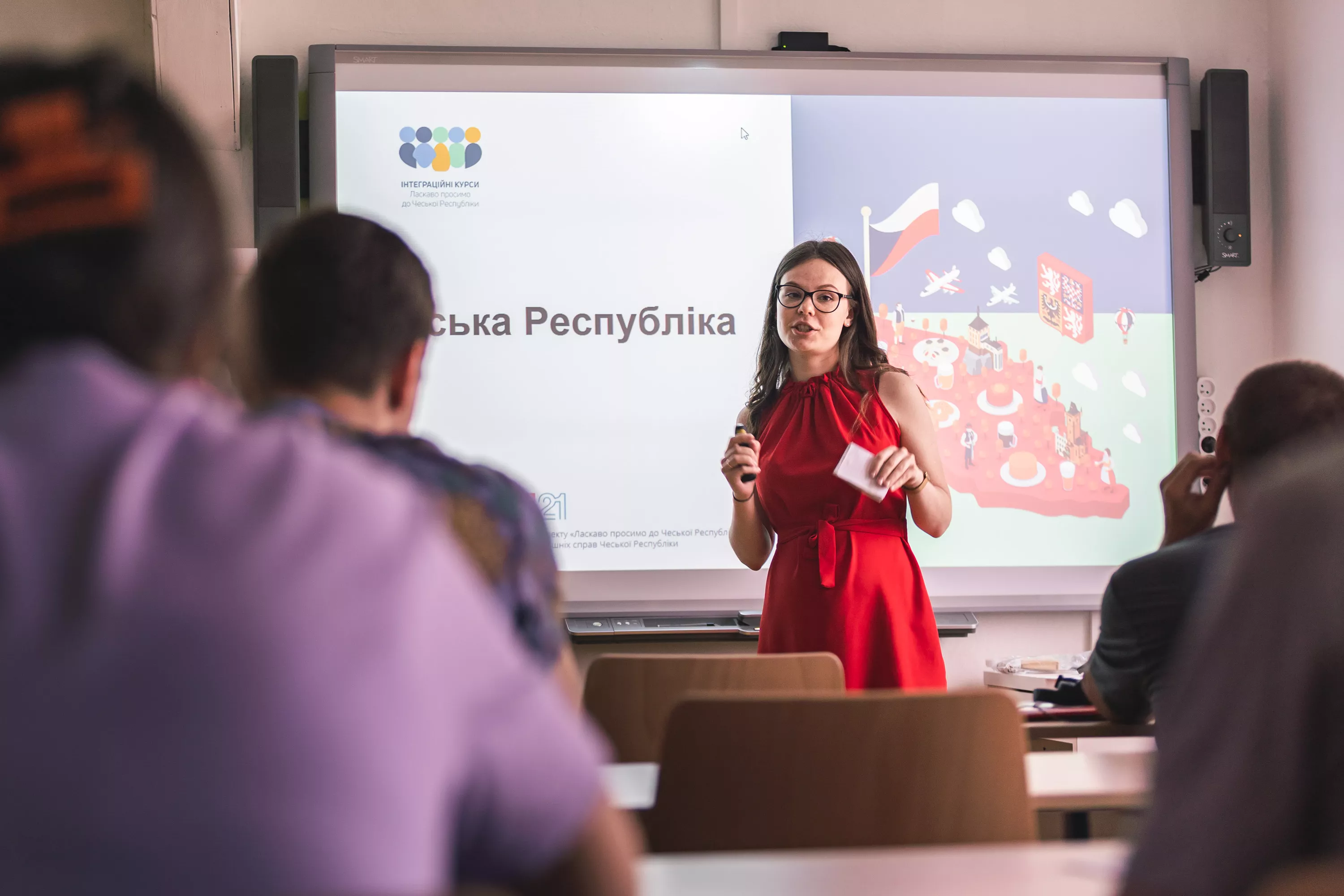
A lot of information! The course lasts 4 hours and is truly packed with information. From basic facts about the Czech Republic, our culture, and points of interest, to "hard" information such as obligations for foreign nationals, deadlines for submitting applications, and the like. The course instructors work a lot with group dynamics, alternating lighter, more relaxed topics with more complex ones that are, however, extremely important for the participants. And last but not least, the foreign nationals leave the course with contacts for integration centers and non-profit organizations for foreign nationals that they can turn to when they need help. In my experience, most course participants are completely unaware of the centers and services for foreign nationals, and this is their first encounter with that information.
"I must honestly say that we receive almost no criticism after the course. The quality ratings for the course are truly excellent, as are the ratings for our instructors and interpreters," says Blanka Vosecká Veselá, methodologist for the Welcome to the Czech Republic courses.
What are the courses actually like in practice? How do you communicate with foreign nationals who come to the Czech Republic from all different corners of the world?
The course is attended by an instructor who speaks Czech and an interpreter who translates into one of the nine project languages. These are Ukrainian, Russian, English, Serbian, Vietnamese, Mongolian, Arabic, French, and Spanish. These languages naturally reflect the numbers and origins of foreign nationals in the Czech Republic. Upon request, however, it is possible to organize a course in another language—we call them "rare" in the project—if there is interest and if the foreign nationals do not understand any of the previous languages. We have therefore held courses in Japanese, Chinese, Thai, and other languages as well. Last year alone, over seventeen thousand people went through the courses.
Do you have any feedback from participants that the courses actually help them find their way in a new country? Or do they consider it more of an obligation that they simply have to fulfill?
We have feedback from everyone who is willing to provide it after the course. Every course participant can fill out an anonymous online evaluation questionnaire and write down their observations, comments, praise, and criticism. However, I must honestly say that we receive almost no criticism after the course. The quality ratings for the course are truly excellent, as are the ratings for our instructors and interpreters.
So, no major criticism?
Every now and then, someone writes to us that they missed some information in the course that was important to them. To give an example, someone might write that they didn't learn how to get a fishing license here. We are happy for that feedback, but after all, the course is 4 hours long, and we simply can't cram everything in. That is exactly what integration centers and non-profit organizations are for, as they can deal with individual matters and details with the foreign nationals. On the contrary, before the course, foreign nationals are often really skeptical; they don't want to go, they don't want to pay, they would rather be at work or have time off. But in the end, most of them admit that the information was useful to them, and we have heard many times, "If I had gone to that course sooner, I wouldn't have done this wrong / I could have saved money / I would have known where to get help," and so on.
Are there actually any consequences for foreign nationals if they do not complete the course?
Yes, by law, they face a fine if they do not complete the course within the prescribed period, which is within one year from the date of receiving their residence permit card. A fine of up to 10,000 CZK can be imposed, and it can even be imposed repeatedly! That is why we strongly recommend that everyone who has the obligation to attend does so.
Related projects
Welcome to the Czech Republic
The first step toward a successful start to life in a new country. That is the Welcome to the Czech Republic adaptation-integration course, which Slovo 21 has been developing since 2013. Today, our courses are mandatory by law for certain foreigners, and we continue to ensure they remain high-quality and provide up-to-date, verified information.