“Intuition led me right here.” – A conversation with Gleb from Belarus about leaving home unexpectedly and discovering Prague
.jpeg)
The 2020 Belarusian elections led to the re-election of the authoritarian president Alexander Lukashenko. The situation became complicated for many people who found themselves in uncertainty or danger. The journey of a young man named Gleb to the Czech Republic was a long one. Accepting his difficult fate with resilient optimism helped him cope with the complications. He came into contact with Slovo 21 through the New Home project, which helps holders of international protection navigate the often confusing circumstances of life in a new country.
What were the circumstances of your departure from Belarus?
I haven't been in Belarus for three and a half years, and a lot has changed in that time. My outlook on life has shifted, and you could say my life has been divided into the period before I left and the period after. Sometimes it's hard to recall the reasons why I left because those three years were emotionally intense. Not in a bad way, but there was so much going on, and sometimes I need time to remember things. One of the reasons was the political situation in Belarus. My friend and I moved to Kyiv, Ukraine. We only had a month to make the decision to leave. My friend had previously worked for the militia—that's the Belarusian police. After he quit, they told him he had one month to go into hiding.
So you left together?
Yes, together. Another turning point for me was when he said: "Buddy, if they didn't come for you today, they will come another time. There is a list of names, and your name is on it. They didn't come for you only because there were others ahead of you in line. It's just a matter of time."
I don't know why I was on that list at the time. But I knew it was better to leave than to stay and wait to see what would happen to me next.
And how long were you in Kyiv?
From the beginning of November 2021 to the beginning of March 2022, so about four months.
Why did you choose to come to the Czech Republic specifically?
Because it was on the way out of Ukraine. I didn't have any specific plan, and I hadn't planned on moving away from Ukraine before the invasion began. Everything that happened afterward was intuition and coincidence. I'm not a very intuitive person, but back then, my intuition led me right here. I didn't know why.
According to Ministry of the Interior data, there are now around seven thousand Belarusians in the Czech Republic. Are you in contact with any members of this community?
I am not. I know a few Belarusians here whom I talk to, but most of the time I see Czechs or Ukrainians.
People who decide to return to Belarus often face immediate danger. Have you ever thought about going back? Is there any trend of people returning at all?
Yes, there is a trend. Just yesterday, a friend from Belarus visited me. We talked about going back. He doesn't have any politically problematic history; he moved to Poland, but he still goes home every once in a while. And just because he has stamps from Ukraine in his passport, he often runs into problems at the border when returning to Belarus. It’s really quite intense at the border.
He also told me about a Belarusian friend of his in Poland who liked an opposition post from abroad. When she went back home, they tracked down that like and threw her in jail for several days. Just for liking a single post. It’s crazy.
So, for you, returning is no longer an option?
It isn't, I’ve come to terms with that. I’m not saying it’s sad. It just is what it is. Some people have it worse, some have it better.
Are you still in touch with people from Belarus?
Yes, we are still in contact with acquaintances. I call my parents, and sometimes friends come to visit me here when they have the chance to get a visa.
And what was your arrival in the Czech Republic like?
Phew! (laughs) I spent my first night in Prague at the Ankali nightclub. That was probably a result of intuition, too. I didn't know anything about the Czech Republic, I didn't know my way around Prague, and I ended up right there on my first night. When I arrived, I was looking for some kind of accommodation or hostel, at least for the first night. I found a website where Czechs were offering housing to newcomers. I came across the contact of a guy who was willing to help me. He told me he’d be happy to let us stay with him, but he could only do it starting tomorrow because he had a DJ set at Ankali that night. I didn't have anything to do that night anyway, so I told him to send me the address and that I’d show up too. We’re still good friends to this day.
How difficult was it for you to obtain international protection?
It wasn't easy. In Prague, I only knew about the congress center, where there was a huge booth helping refugees. But they were only helping Ukrainian citizens or people with permanent residency in Ukraine, which I didn't have. I only found that out once I got to the booth. For the whole week after that night at Ankali, I was going to various places in Prague, to the Ministry of the Interior... trying to figure out what I needed to do and how I could legalize my stay here.
In the end, I went to Brno, where there is a refugee camp, and I ended up spending two weeks there. I had an interview, then I got an asylum seeker card, which I only had to renew once every six months.
How did you get involved with the New Home project?
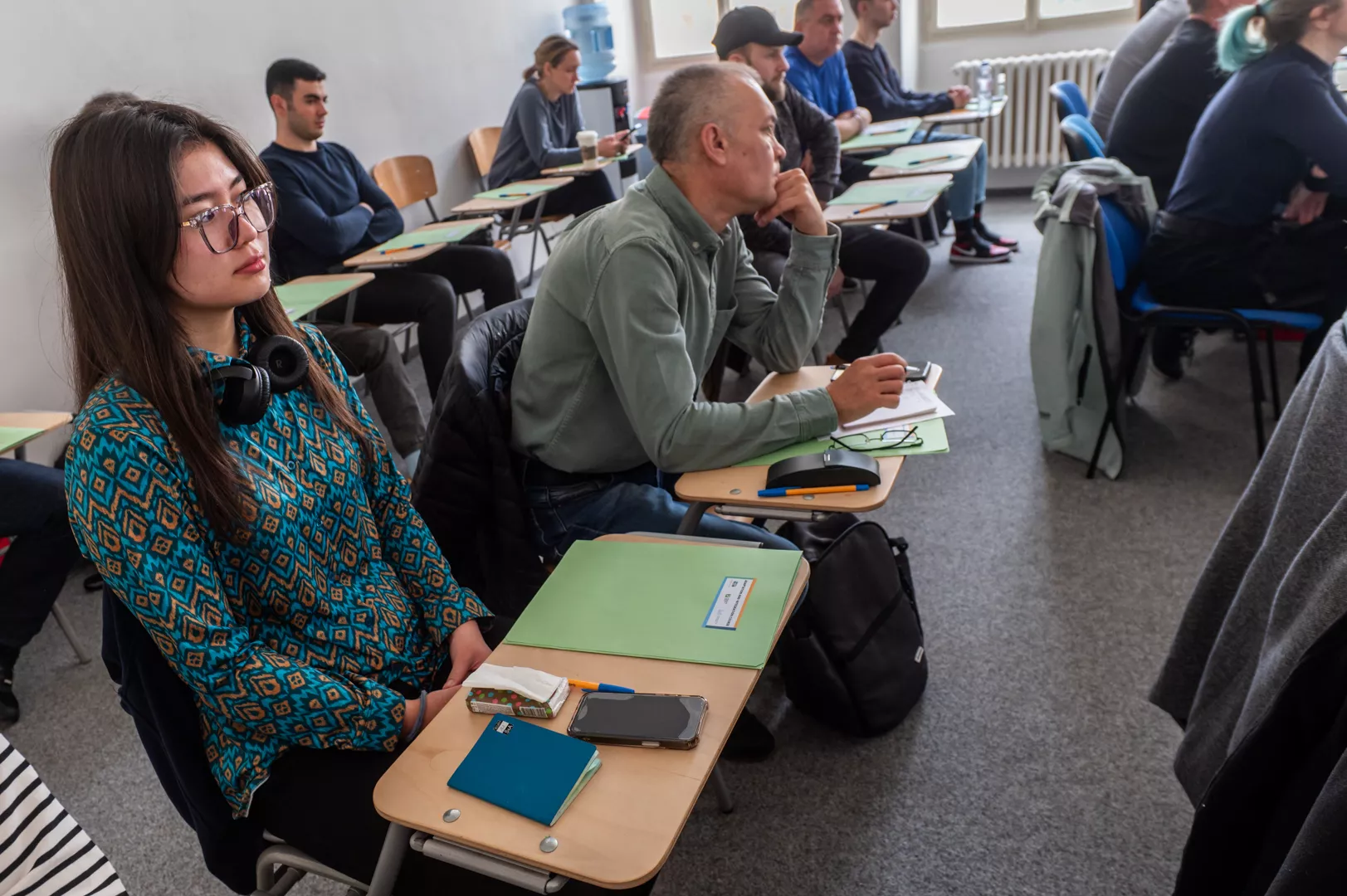
That question should be asked the other way around. I’d rather ask how the project found me. One day, a woman who works here, Tihana Valent, called me. She told me there would be a meeting about integration issues. So, I signed up.
Did you find the course useful?
It was definitely useful, although I received all that information three years too late. The seminar only took place three months ago.
For me, the best part was being surrounded by truly great people—Czechs who were well-versed in legal and social matters. I am incredibly grateful for that.
What was the biggest barrier for you after arriving in the Czech Republic?
The most fundamental barrier was the language. At first, I spoke English and started learning Czech gradually. I had my first few Czech lessons in the refugee camp. I also watched YouTube videos, but I mostly learned through direct communication with people.
And how is life here for you after three years?
Beautiful. Currently, I work in a kitchen, I also help sculptors make concrete molds, and most importantly, I learned how to make ceramics here. I’ve even started teaching ceramics courses to others. I got into that here because I had a lot of time to come up with new things... Again, it was more like the hobby chose me rather than me choosing it, because the ceramics studio was right next door to where I lived.
It sounds like things have been finding you, rather than you finding them.
Actually, yes. Looking back, that’s exactly how it is. I couldn't have put it better myself.
Do you follow the situation in Belarus?
Mostly just through friends and acquaintances now. During the first year, I followed it quite intensely, but then it just started draining my energy.
Is there anything you would like to say to people from Belarus who are coming to the Czech Republic?
When friends come to visit me, I show them the non-touristy side of Prague, take them out into nature, and so on. But to those still in Belarus who are thinking about moving away permanently, I usually say that the grass is always greener on the other side.
Moving doesn't automatically mean life will get better. Everywhere you go, you have to educate yourself, work, and communicate with people. You might get rid of some problems, but you will always have to face other complications. However, if you stay, nothing will get better anyway.
.jpeg)
Interview by Sára Procházková.
This interview was produced as part of the New Home in the Czech Republic 2024–2026 project, co-funded by the European Union.
Our Partners

Related projects
Your New Home in the Czech Republic
An unfamiliar country, traumatic experiences, emotional burden, a lack of information, and an uncertain future: these are all challenges faced by holders of international protection. Through our integration seminars and a comprehensive publication, we strive to provide sensitive support to help them integrate into Czech society.