"Nobody tells us Roma who we are." Sebastian describes his experience at the We Are On the Long Way summer school
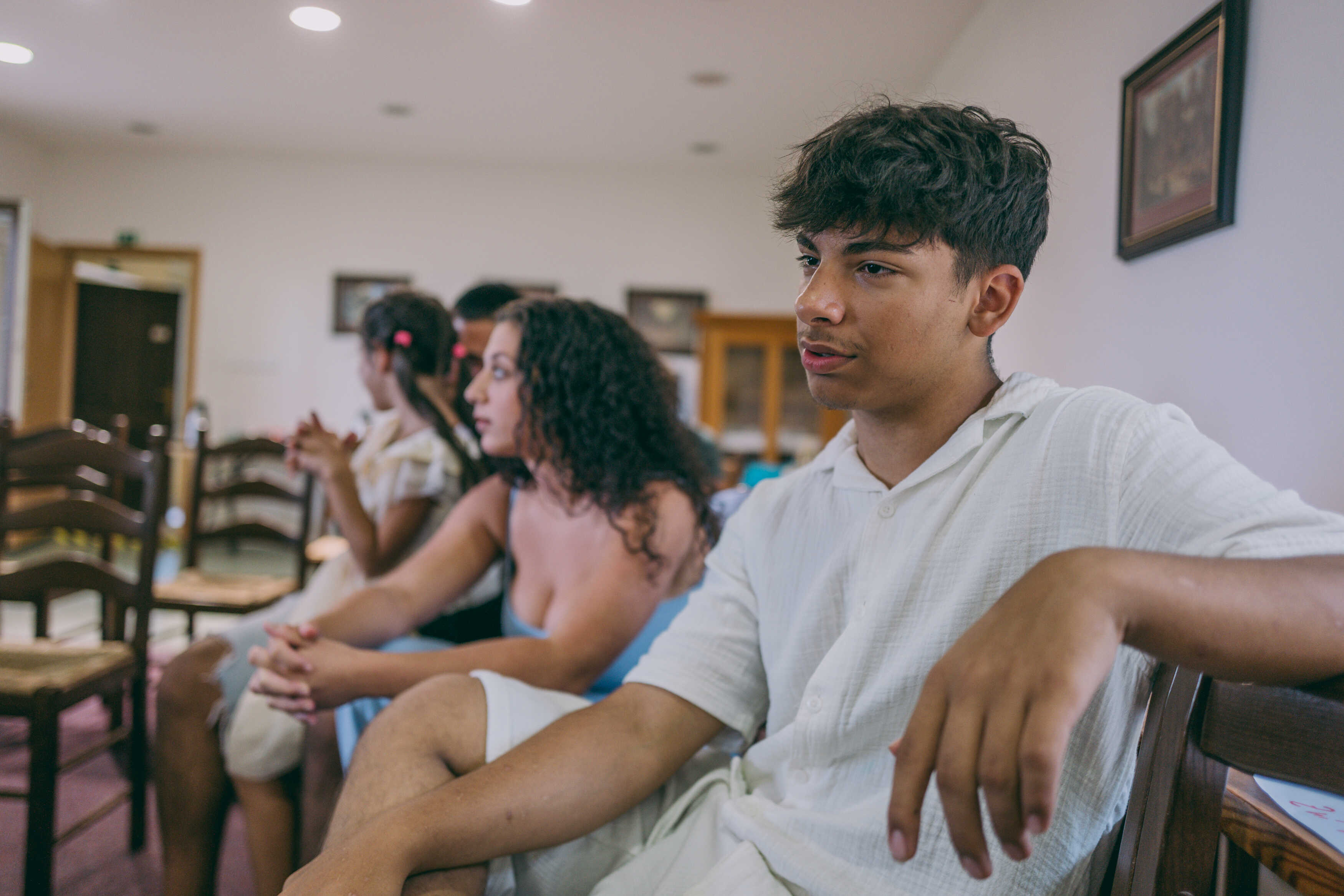
Jdeme dlouhou cestou is no ordinary summer school. It combines several goals: strengthening Romani pride, learning about one's own history and culture, and motivating young Roma to get involved in the fight against anti-Gypsyism. Sebastian is one of this year's participants. In this interview, he talks about what was new for him and why he sees such education as meaningful.
Did you like the idea of going to the summer school from the start?
I’m up for anything, so I was really happy that I could be there too. I thought I’d meet new people, have a lot of fun, and get a chance to find out who I actually am. In the end, it was an unforgettable experience for me.
What do you mean when you say, "Find out who I actually am"?
Nobody really tells us Roma who we actually are. But at this camp, we learned at least a little bit about our history. Who we were, why we were, what we were, what we’ve been through. What our culture is exactly, and so on. So I think I’ve at least partially figured out who I really am.
Had you had the opportunity to think about things like this before?
It wasn't the first time I’d thought about it, but before, it was only when my parents talked to me about it. Otherwise, I couldn't really get to it at all. That’s why I was so glad I could be at an event like this.
How did you feel about the group of participants?
Since it was for eighteen-year-olds, I was a little stressed. I’m fifteen, and I thought they wouldn't want to bother with a kid. But it was the complete opposite. We actually became friends right away. Honestly, I don't think I’ve met kinder people than the ones there.
Did you notice that there were people with different levels of education, from different backgrounds, and so on?
Yeah, definitely. Those who were already in high school gave me advice. I’m just starting high school now, so they advised me on what to watch out for and things like that. They even gave me tips on scholarships.
Is there anything specific that really stuck with you?
Definitely anti-Gypsyism. And our history.
Was that the first time you’d come across the term anti-Gypsyism?
Yes, that was the first time. And for most of the participants, it was something new, just as it was for me.
Did you also discuss how to stand up to manifestations of anti-Gypsyism?
We talked about what exactly anti-Gypsyism is, and most importantly, how to recognize it. Once I understood that, I was only interested in one thing: "How should I defend myself when I experience it?"
I remember one example we discussed. Our instructor, Nikolas, told us that a teacher in elementary school once said to him, "Wow, you’re good at shouting. It’s just in your nature." She probably meant that Roma people go around shouting in the streets. I asked Nikolas how I should react to that, and he just asked me what I would come up with myself. I thought I’d say something like, "What do you mean by that? What do you mean 'you'?" And Nikolas replied, "See? That’s perfect. I didn’t even have to answer for you."
So, the important thing is just to speak up?
Yes. But it also depends on how you speak up. Because if I did it the wrong way—like if I started shouting at her, asking how she dared, or using profanity—that wouldn't be the right way to handle it. It’s better to just ask what they mean. The teacher would immediately pause and realize she had said something wrong.
So, you enjoyed the history part as well…
They did it in the best way possible. We each had a role and acted it out. We were in the roles of Roma people traveling the world. The instructors blindfolded us and led us through things like a jungle. We had to hide, just like the Roma did in history. We were able to actually experience it. If you were just sitting there listening, you’d be bored within an hour, you’d want to sleep, or you wouldn't pay attention. But they organized it in a way that kept everyone engaged while ensuring we all took a lot away from it.
Would you like to go to a similar event again sometime?
Definitely. I heard that Jana (program coordinator Jana Hejkrlíková) wants to organize it again next year. I would be incredibly happy if she did, because we need more events like this for many more people. There were people there from our town, Písek, who arrived with the mindset of: "Well, we’re Gypsies, we’re troublemakers." I’m not saying they said exactly that, but something similar.
And I absolutely didn't expect them to take so much away from those four days! After those four days, they left saying, "Wow, I’m not a 'Gypsy,' I’m a Rom, and our culture is rich, and I have absolutely nothing to be ashamed of." They had never had anyone explain to them properly what it means to be Roma before. This was the first time someone had actually talked to them about it.
Is there anything else on your mind that you would like to share?
What I have on my mind is that these events are definitely not a waste of time. Not at all. After seeing the progress they made with us, I just wish there were more events like this. We got home and we really missed the program. And that’s coming from the guys from Písek, who spent three days complaining that they didn't want the program. Then they got home and said, "Man, we miss the program. We want it back."
The We Are On the Long Way summer school was held as part of the We Are On the Long Way project under the auspices and with the financial support of the ERGO Network.
Funded by the European Union. Views and opinions expressed are however those of the author(s) only and do not necessarily reflect those of the European Union or the European Commission. Neither the European Union nor the granting authority can be held responsible for them.


Related projects
Ergo NETWORK
Strength lies in unity. At the European level, we collaborate with 30 other Roma and pro-Roma organizations working in the field of Roma inclusion. Together, we are united under the ERGO network, which defends the interests of the Roma, organizes public campaigns, supports Roma activists, and communicates with policymakers at both the national and European levels.
%20(1).jpg)