"I grabbed my two children and we fled toward the Carpathians." That is how the war in Ukraine began for Kseniia.
February 23, 2024
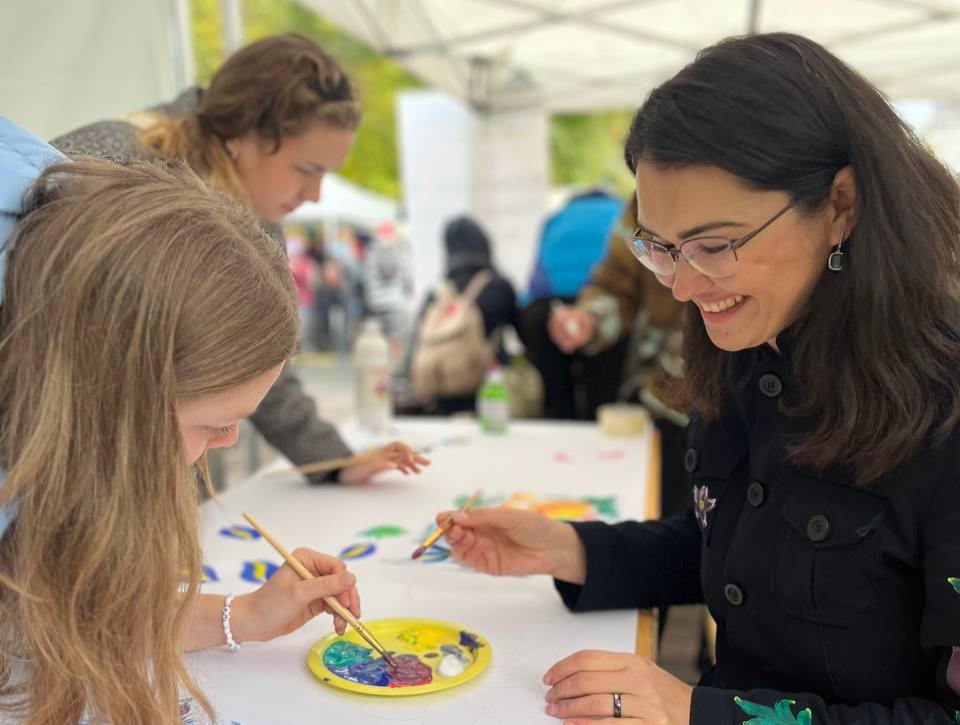
Kseniia Zakharova is a scientist, university lecturer, and painter originally from Ukraine. She has been in the Czech Republic since April 2022. This was the second time she had to say goodbye to her home in Ukraine; in 2014, she was forced to leave the Crimean Peninsula following its annexation by Russia. She channeled her experience into an art therapy method, Petrykivka painting, which she introduced to Ukrainian refugees in collaboration with Slovo 21.
What were you doing when you found out that the war in Ukraine had broken out in full force?
I was one of the first to know that the full-scale Russian invasion of Ukraine had begun because I was two kilometers from the military airfield in the city of Hostomel, which the Russians started bombing at 5 a.m. on February 24th. I grabbed my two children and the canvases that were standing in the hallway, and we fled toward the Carpathians. My mother refused to leave because she didn't believe the Crimean scenario would repeat itself. We had already had to evacuate once back then. After my mother managed to escape to safety, I arrived in the Czech Republic with my children.
What exactly are you focusing on in the Czech Republic?
Pedagogy and science. In Ukraine, I taught at the National Economic University and focused on the development of competitive strategy science. After the war began in 2014, I spent a lot of time volunteering, helping military families and war veterans themselves gain new qualifications, and assisting in their integration into society in every way I could. I developed and implemented an art therapy program based on ornamental decorative art: Petrykivka painting. It was through this that I met incredible people who know what it means to be a refugee. I also realized the importance of working with national health, which is why I organize workshops for refugees from Ukraine, but not only for them. After all, as we know, art has no skin color, is not subject to judgment, and raises no questions; it brings joy and heals. I cannot find a permanent job here, but I participate in many projects generally related to the integration of refugees from Ukraine.
"We lost everything that gave my children peace, emotional warmth, and a sense of family. We experienced manifestations of xenophobia and racism firsthand," says Kseniia Zakharova, a scientist, university lecturer, and painter originally from Ukraine.
How are your children coping with life in the Czech Republic?
The children adapted very slowly and very painfully because we literally lost all contact with our loved ones. We lost everything that gave my children peace, emotional warmth, and a sense of family. We experienced manifestations of xenophobia and racism firsthand. It involved bullying at my eldest son's school, poor attitudes from parents at kindergarten, and aggression on the street because of my car's Ukrainian license plate. After learning the language and integrating into Czech society, I realized that my work primarily helps my children. Because we are now interacting with decent, intelligent, and interesting people.
Are you in touch with family or friends in Ukraine?
My husband is a veteran of the Russo-Ukrainian War and is in Ukraine. He could join us, but he won't, because he is helping his brothers and supporting the economy of a country that is fighting for its freedom with blood and death in every way he can. As I mentioned, my mother and my closest relatives are also in Ukraine.