I was surprised by how many women shared their experiences with domestic violence. – With Claudia Laburdová about the Speak Up project
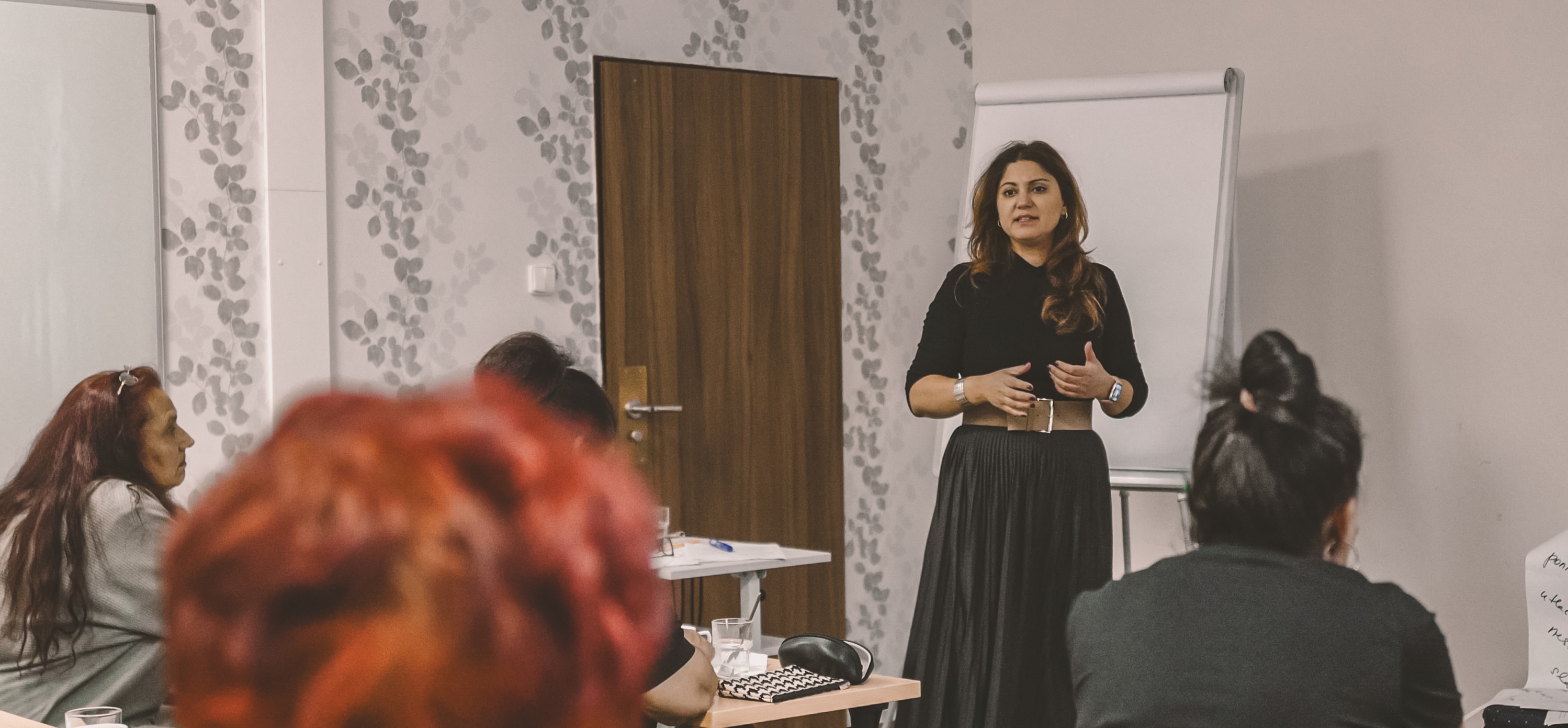
The Speak Up project, focused on raising awareness about domestic violence within the Roma community, has been running since September 2023. Under the leadership of coordinator Claudia Laburdová, it has come a long way. At the heart of its various activities is the effort to inform women that violence in any form is not okay and that they do not have to face difficult situations alone. As part of the project, self-help groups were established in five Czech cities, where women have had the opportunity to reflect on their own experiences and discuss ways to find a way out.
What was the initial idea behind the creation of the Speak Up project?
The core theme of the project is the prevention of domestic and gender-based violence in Roma communities. Of course, we know that this is a society-wide issue and that the majority population has been addressing domestic violence for some time. Still, we were a bit afraid to, so to speak, dive in and start opening up this topic or working with it. However, we had occasionally encountered the issue of domestic violence in previous projects. Local coordinators themselves gradually began to point out various stories of women within local groups, which at that time were still dedicated to community organizing. So it was clear what we wanted to continue doing.
How many people were involved in preparing the project?
Five coordinators in five cities across the Czech Republic, each with a group of ten women under her. The target group is therefore fifty women, but of course, when one woman learns new information—for example, where to seek help if someone is suffering from domestic violence—the information naturally spreads further.
The project works with the concept of domestic violence prevention; what can we imagine under this prevention?
For us, it is mainly about opening up the topic of domestic violence and starting to speak about it out loud. To say that it is not okay and that women who suffer from any form of domestic violence should not stay silent. Because in Roma communities, it is quite often a taboo; people don't talk about it. And unfortunately, women often perceive it as a normal part of life. After some time, they get used to it and simply accept it as it is. It is probably quite similar in the majority population as well.
But in Roma communities, it might be harder to get out of that environment. In any case, Roma women often approach domestic violence as a normal part of life.
Sometimes there may be a lingering feeling that domestic violence is rooted in traditions within Roma communities...
That is definitely not the case. I have heard that before, too, but domestic violence really does not belong to any customs. Of course, it happens that we sometimes hear, "But for us Roma, it's normal." But the answer is that it simply isn't. There is no rule that a man is so superior that he can hit his wife at home, or humiliate her, or oppress her in any other way.
How are you trying to support women through this project?
Through the Speak Up project, we decided to open up the topic, discuss it, and share information about it. Especially regarding the various forms of domestic violence. About the fact that it is not just physical violence, but that psychological, social, economic, and sexual forms exist as well...
We try to get that information to the women who need it. And then, of course, we also share information on where to seek help if a woman wants to break out of such a cycle of violence. If a woman truly decides to end a pathological relationship, she needs information on where to find help.
In the project, we have an expert from a psychological counseling center for these cases—coincidentally, she is also a Romani woman, which is great because she understands the context. If we find a woman who wants to address her current situation, this expert helps her in the initial phase and, if necessary, directs her to professionals at organizations like Rosa or Acorus. There, women receive support from therapists who guide them through the entire process of potentially leaving and help them create a so-called safety plan. But only when they truly decide that they do not want to be in that relationship—that is incredibly important. A victim of domestic violence must not be pushed into any decision. The woman must decide for herself. That is the most fundamental rule. We are simply not a social service. We are not equipped to help victims of domestic violence in the sense of guiding them through the entire process, which is why we prefer to leave that to the professionals.
You have been dealing with issues related to domestic violence in the Romani community for a long time. What have you discovered?
Two years ago, I thought it would be difficult to open up this topic. I thought women wouldn't want to be open, and that once we started talking about the manifestations or forms of domestic violence in self-help groups, they would get scared and run away. But that didn't happen. This means that the time is finally right for this debate. I was surprised by how many women shared their own experiences, or the experiences of their loved ones, and how many women were happy that it was finally being talked about.
In any case, our advantage is that we have coordinators in the given cities who have been working in these locations for several years; they act as natural authorities and have the trust of the people, and especially the women in the groups. So, the topics I bring are well-received by the women in our target groups; they discuss them and are able to talk about anything.
It sounds like Romani women have kept the topic of domestic violence bottled up for a long time and welcome the opportunity to open up.
Exactly. We even see this in the reports from our coordinators. When we reached the topic of domestic violence, their feedback was that they are glad it is finally being discussed openly somewhere. There is a form of therapy in that.
All these activities focus heavily on women. Have you ever thought about a dialogue with the other side, i.e., the male part of the whole issue?
Within the current Speak Up project, we haven't dared to do that yet; after all, this was just an initial kick-off for this topic. However, we are planning a continuation of the project for the next two years, and we are already involving men in some of those activities. We are counting on a method called Theatre of the Oppressed, where men will be present, and we will discuss how they see things with them as well. So, we are moving forward in small steps. But, for example, at the workshops we held this autumn, we also talked a lot about raising the next generation. Women are, of course, part of raising their daughters and sons. A quite nice discussion emerged there about raising boys and girls. About how many things stem from childhood and upbringing. So, perhaps through that as well. We are trying to approach the whole issue from different sides, broadly.
What activities are included in the project?
There is the summer school, which has already taken place, the research, which will be presented at Khamoro, and then the self-help groups in five cities. We are now in the final phase of the project, during which we are preparing podcasts and spots. A series of four of each will be created, and I am curious to see how it turns out; we are venturing into something like this for the first time.
What kind of podcasts and spots are they?
They will look at the entire project in a way. A debate about the research and the individual activities will certainly be included. We would like to talk to an expert who works with victims of domestic violence about specific forms of help. And we would like to dedicate the last two podcasts directly to victims of domestic violence. So far, four women who have experienced something like this and have, fortunately, put it behind them have agreed. They have processed it and would like to let other women know not to put up with similar treatment.
What was the idea behind the need for research on domestic violence in the Roma community?
No such research had been conducted in Roma communities in the Czech Republic. While general studies exist, we don't know how many Roma women participated in them. So, we thought it would be beneficial to have our own research before launching the project fully. We wanted to see how these women recognize different forms of domestic violence and whether it is the right time to start talking about this issue in Roma communities—which, as it turned out, it is.
Can you share any of the research findings yet?
Actually, I can't yet. The presentation will take place at Khamoro on Saturday, May 31st, at 2:00 PM at Hotel Olšanka. We will introduce the entire project along with the research results, which will be presented by Selma Muhič Dizdrarevič. She prepared the questionnaire, the evaluation, and the entire research report, so she is the most qualified person to speak about it.
The "Speak Up" project, registration number CZ.03.02.03/00/22_044/0002151, is funded by the Employment Plus Operational Programme.
The project is funded by the European Union.
Related projects
Speak Up
We must talk about violence against women! This is especially true in the Roma community, where the topic has long been a taboo and is often downplayed. In five Czech cities, we will emphasize to Roma women that domestic violence is by no means a part of Roma traditions and has no place in any society. At the same time, we plan to conduct research, as relevant data on violence against women in the Roma community is currently missing in the Czech Republic.
.jpg)