"It was like being among our own!" Romani children from a children's home find role models and a sense of belonging to their community through their partnership with Slovo 21.
.jpeg)
Slovo 21 has long been committed to supporting Romani children and youth on their journey through education and life. That is why we are so pleased with our ten-year partnership with the children's home in Česká Kamenice. Through the Khamoro Kher program, children from the home have been attending the Khamoro festival for ten years. As part of the Avela program, we were able to organize a summer camp for the entire children's home, focusing on themes of Romani identity and financial literacy. Thanks to the program, the home also hosts tutoring in Romani, mathematics, elementary science, physics, English, and Czech, which 13 children are participating in this year.
In Česká Kamenice, a town located north of Ústí nad Labem, darkness falls early in late September. I am standing in front of the children's home building with Zdeněk Lažanský, a local educator. "This place is just a part of my life; I've been working here for twenty years," he says. It was he who first brought the children from the local home to Khamoro ten years ago, establishing a partnership with Slovo 21 that continues to this day. "Two-thirds of the children in the home are of Romani origin, and they don't see anything of their own culture around here," he explains, describing why he decided to take the children there.
More than just tutoring
The children meet in a room on the ground floor. A Romani language lesson awaits them. The walls are covered with colorful paper decorations, and a nearly life-sized plush giraffe stands in the corner. Mirka Tulejová tutors Romani here every week; she and Robert Tonelli accompanied the children during Khamoro, and both were with them at the summer camp as well. I soon realize that these weekly meetings go far beyond language instruction. Robert himself grew up in a children's home, and Mirka was raised in foster care by her Romani grandmother. Both are easily able to empathize with the feelings the children in the home experience. "The first part of the lesson, I just talk with them. I want them to know that I was raised by a Romani grandmother in foster care. They need to hear about Roma who did the right thing and helped others," Mirka adds.
Financial literacy and finding role models
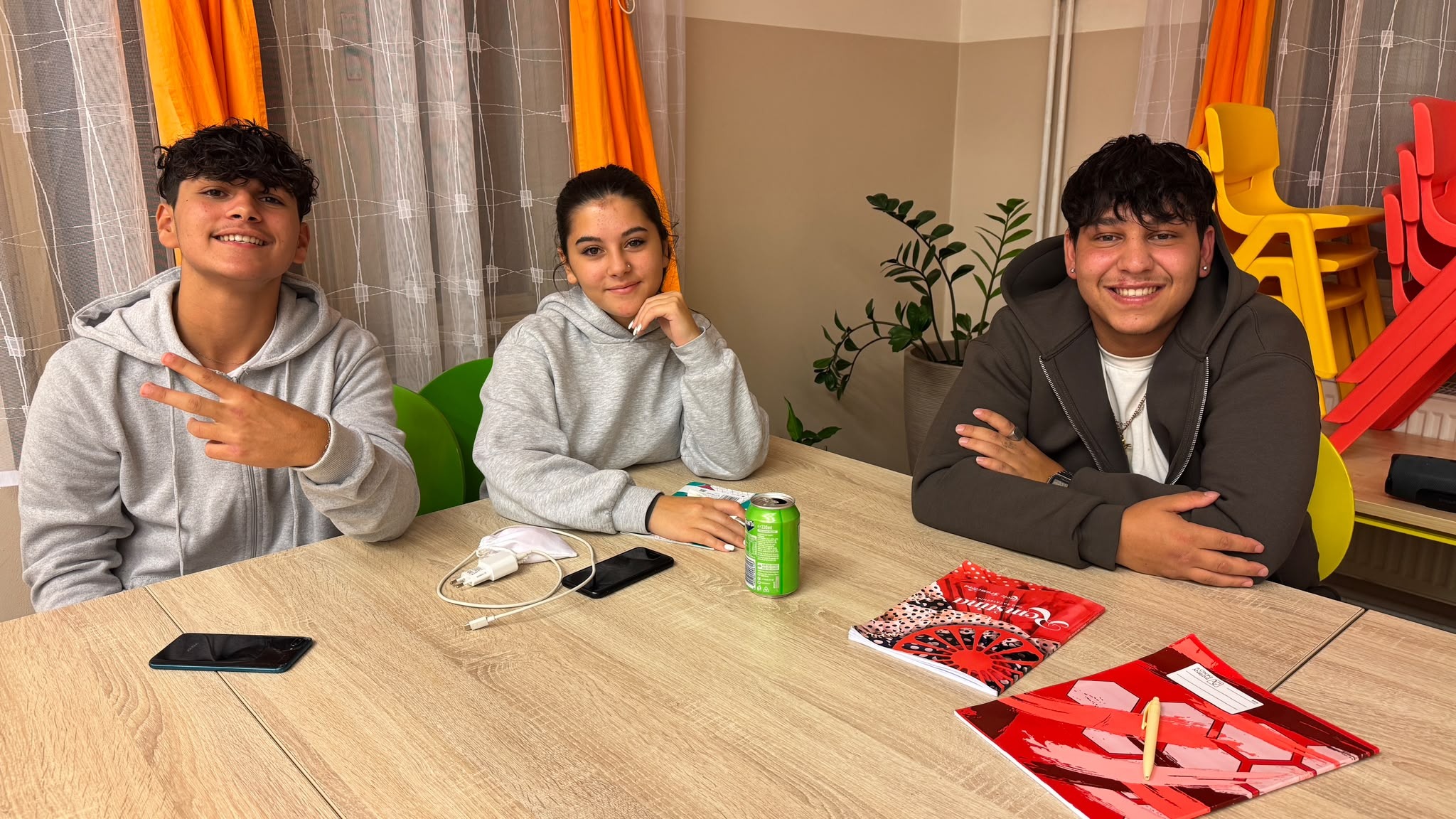
I stay in the classroom for a while after the Romani lesson, curious about how the children remember the camp and Khamoro. "You know, the two of them are just friends to us," explains a girl in a blue sweater who looks to be about fourteen. "But the program was also great. For example, I'm going out on my own soon, so the financial literacy was useful. Knowing how to plan so you can make it through the month on your paycheck and stuff..." adds a boy who will soon be eighteen. The girl in the blue sweater has two siblings here. After a moment, her younger brother joins the conversation: "I was nothing but trouble, all the time. It was always something. I wouldn't listen to anyone, not even my older sister." She turns to me and nods significantly. "But since Mirka and Robert have been with us, it's changed; they're just like role models to us." The seventeen-year-old boy nods in agreement and adds: "I tell Robert all the time that he's my role model; he knows it."
Memories of Khamoro
When I mention Khamoro Kher, everyone digs up a memory. "Well, mostly we danced, all the time!" the girls laugh, winking at each other conspiratorially. I learn that the biggest experience for them was the concerts of traditional Romani music. They recall the voice of the Spanish singer, the colorful dresses, and the dancers. "You know, it was something completely different; when we were dancing there, it was just like being among our own," they conclude.
Later, I share with Mirka and Robert how enthusiastically the children spoke with me. "It's nice that they feel that way themselves; that's actually the purpose of it all," Mirka nods. "This year, together with the Bobeš association (an organization through which Robert focuses on supporting children in homes beyond just the Avela program), we will be hosting a Christmas party for them. Last year, Slovo 21 also contributed to it. It's not enough for us to just come to the children's home, give them gifts, and leave. We want to share that dinner with them; we want them to get to know us and for us to get to know them. We want to know their stories – what happened and why. Just think about it, they say: 'We want to be like our uncle.' That's why I know our work here in Kamenice has meaning."

Related projects
Avela
We motivate and support Romani children and youth to discover how education can change their lives. Through the Avela project, we provide pupils and students not only with tutoring and mentoring but also with a wide range of extracurricular activities to help them develop their potential and broaden their horizons.
.jpg)