A slap is not a sign of love. Romani women open up the topic of domestic violence in a theatrical performance
hlas_1%20(2)%20(1)_11zon.jpg)
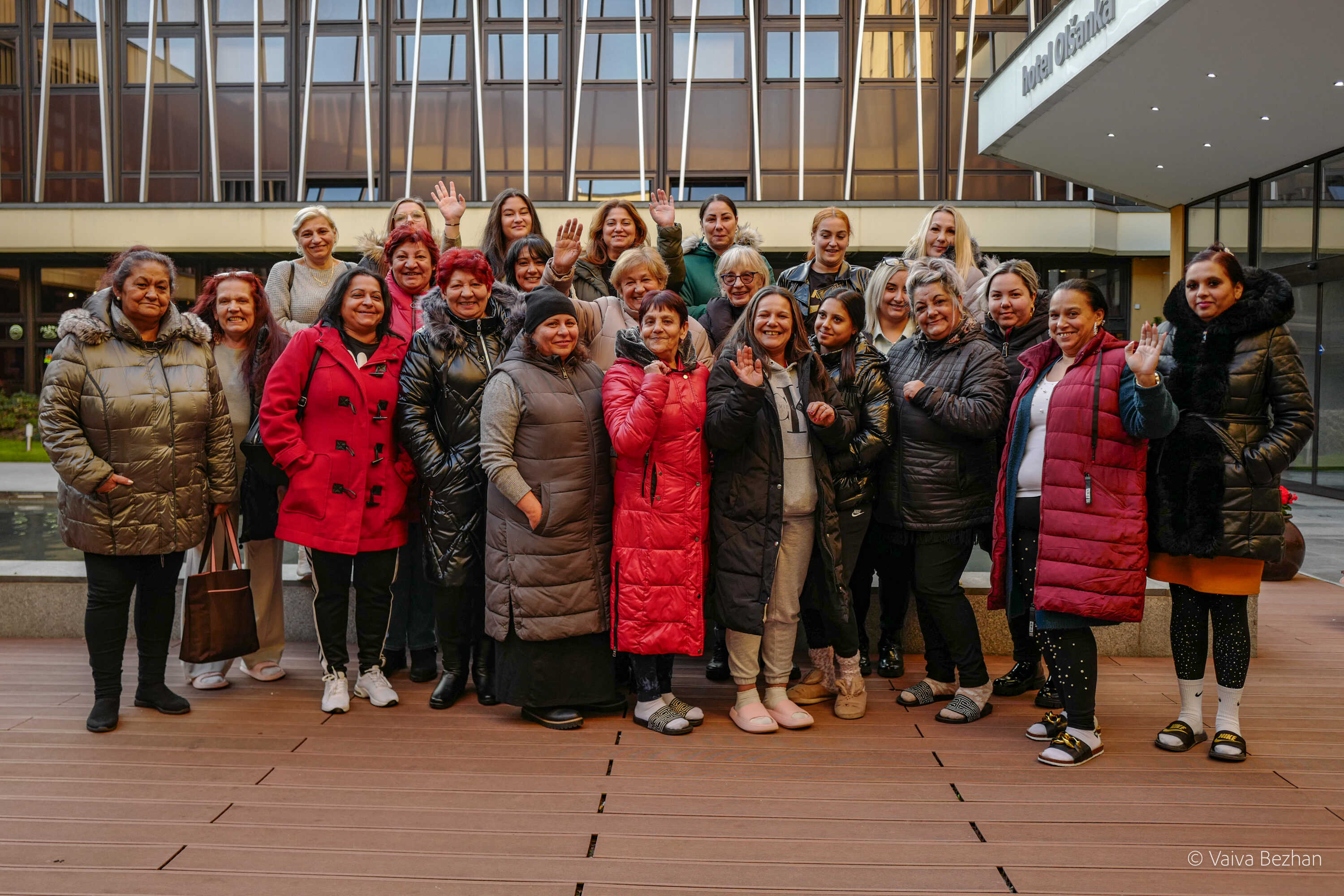
What does it mean to be a Romani woman? And who actually gets to decide that? Expectations, roles, and social pressure often dictate what women experience—and what they keep to themselves. Domestic violence has long been a taboo subject in the Romani community, yet our exclusive research shows that nearly one-third of Romani women in the Czech Republic have experienced it. This is why Slovo 21 created the new theatrical production Speak Up. Romani women were given the opportunity to speak about the experiences of their loved ones as well as their own.
Romani women of all generations gradually take the stage. The production opens with a conversation between a grandmother and her granddaughter. The grandmother’s birthday celebration is approaching, but the audience soon realizes that instead of joy, she feels only anxiety about the arguments and conflicts within the family. "What is our grandmother actually afraid of?" the granddaughter asks the audience. The fear soon manifests itself right on stage.
A reflection of authentic experiences
The Speak Up production was created under the guidance of instructors Dana Moree and Líza Urbanová using the unique Theatre of the Oppressed method. It gives Romani women a space on stage. "In the Theatre of the Oppressed, we work with a model story—those who prepared the performance, the non-actors in the group, present how they themselves experienced the topic. It is a reflection of their life experience," explains Dana Moree. Everything we experience with the women on stage during the performance has truly happened to someone, somewhere. "However, these experiences are woven into a constructed story, primarily to prevent re-traumatization," Moree adds.
"They're going to start arguing again!" the grandmother cries out on stage, while we hear lines like: "You're an engineer, but is the cooking and cleaning done at home?" or "What are you wearing? You might as well have worn a swimsuit." The arguments escalate, and in their defense, the women articulate thoughts that are clearly far from self-evident to many: "A man doesn't always have to have the last word" or "A slap is not a sign of love" stays with the audience long after the performance ends.
Reaching the regions
The play premiered in Prague in the autumn. Now, according to Claudia Laburdová, coordinator of our "Speak Up to Be Heard" project, it is heading to the regions—specifically to places where self-help groups operate as part of the program. These groups provide support to women in the regions and help them find ways out of their problems. This way, the message of the performance reaches the women who may need it most. In the regions, the production has the power to open a discussion on how we can help victims of domestic violence, or, ideally, how to avoid becoming a victim in the first place. Marie Ferencová, one of the non-actors, sees this as the strength of the performance: "I wish for the awareness that it is not normal to experience various types of domestic violence to reach as many women as possible. And also young girls who have yet to enter into relationships with men," she adds.
The production was created as part of the project Speak Up to Be Heard, which is funded by the European Union.
Related projects
Speak up so you can be heard
Domestic violence against women must be discussed openly. This is especially true in the Roma community, where the topic has long been a taboo and is frequently downplayed. Our exclusive research revealed that nearly a third of Roma women in the Czech Republic have personal experience with domestic violence. We want to address a topic that has been silenced for too long. We want to empower the voices of women that were once suppressed.