Romani People
Speak up so you can be heard
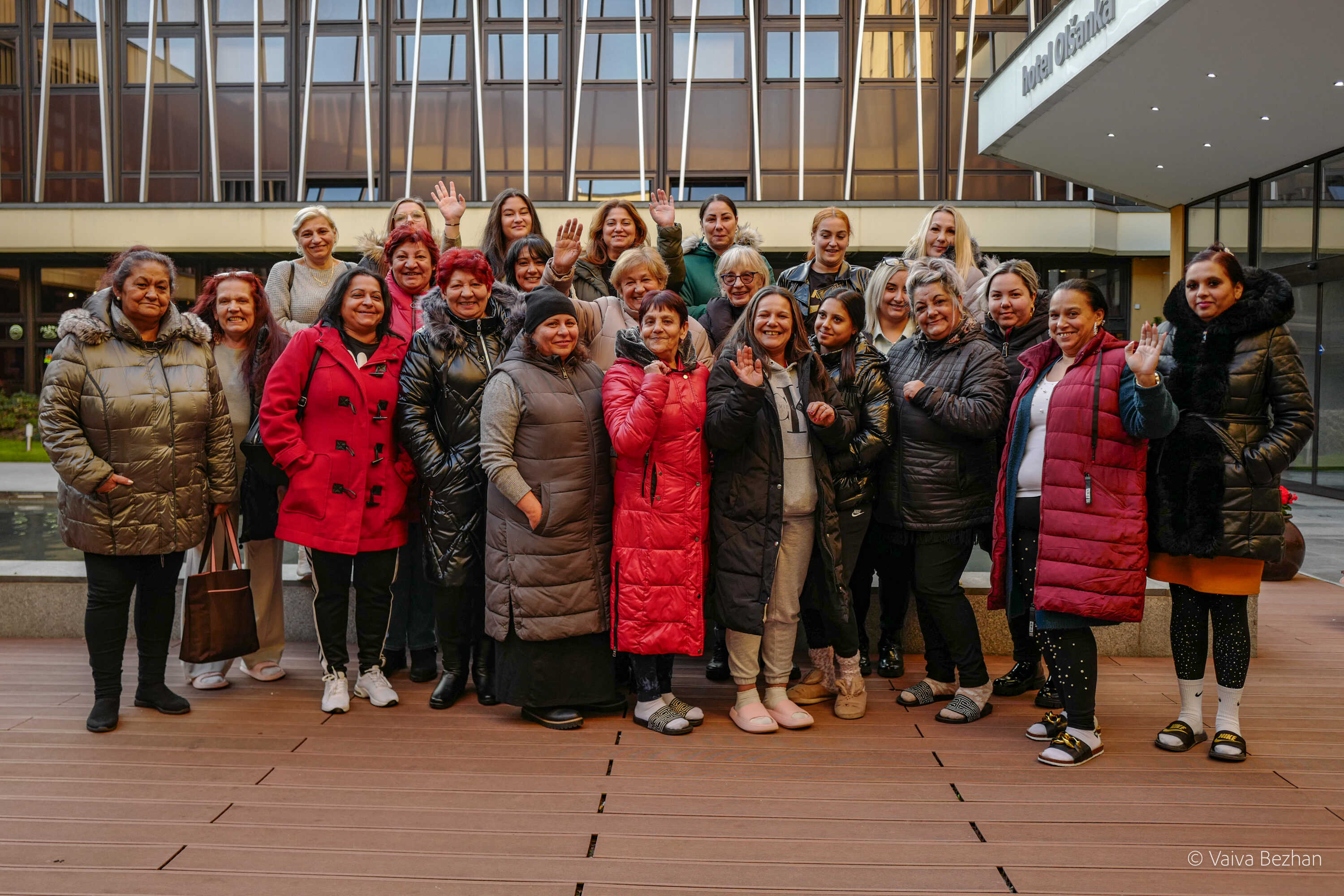
Domestic violence against women must be discussed openly. This is especially true in the Roma community, where the topic has long been a taboo and is frequently downplayed. Our exclusive research revealed that nearly a third of Roma women in the Czech Republic have personal experience with domestic violence. Yet, most victims do not speak about it. They are afraid, do not know where to turn, or feel that no one would help them. We want to change that. We want to address a topic that has been silenced for too long. We want to empower the voices of women that were once suppressed.
• Domestic violence in the Roma community has been silenced for too long. We are bringing it into the open, clearly and loudly.
• We focus on preventing and addressing domestic violence where it is needed most—in five cities across the Czech Republic.
• Our unique research showed that nearly 30% of Roma women have experienced domestic violence firsthand.
• We provide Roma women with a space to speak openly about the problem, share their experiences, and find support.
• Through Theatre of the Oppressed, we are also addressing domestic violence in a new way—using powerful stories, emotions, and open dialogue.
• We are debunking the myth that domestic violence is part of Roma traditions. It is not, and it never will be.
What exactly are our goals?
We want to break the silence surrounding domestic violence in Roma communities. We want Roma women to have the information, knowledge, and confidence to stand up to violence and know where to seek help. We want them to understand that the fault is never theirs. That is why we are creating a space for open dialogue, sharing experiences, and finding solutions. We are involving experts, community leaders, and the women themselves who are most affected by the issue. We are also using unconventional tools, such as the Theatre of the Oppressed, which can speak the language of emotions and bring about change where words alone might fail.
What did our research show?
We were the first in the Czech Republic to conduct relevant and comprehensive research on violence against Roma women, which had been lacking in the country until now. The findings are clear: nearly 30% of Roma women have personal experience with domestic violence. More than half stated that violence in their surroundings is not an exception, but a recurring issue. Yet, very few women seek help from institutions—they most often turn to relatives or remain silent. Fear, dependence on the perpetrator, and distrust in the state system often keep them trapped. That is why, alongside our research, we launched a special campaign in June 2025—impactful video spots that address domestic violence directly within Roma communities and motivate women to start talking about it. The campaign also includes four video podcasts in which well-known Roma journalist Jarmila Balážová discusses domestic violence with professional experts.
What lies ahead?
A series of important activities that share one common goal: to give Roma women a voice, a space, and the strength to speak out. Self-help groups will continue, providing women with a safe environment to share experiences and find solutions. A summer school will offer young Roma people a space to learn how to prevent domestic violence and how to respond when they encounter it. We will also expand the project to other cities so that the topic reaches as many people as possible. In 2027, we plan to organize an international roundtable to share experiences with organizations from other countries and find new ways to tackle the problem of violence together. At the very heart of the project will be the Theatre of the Oppressed—a powerful and unconventional tool that can open up taboo topics through stories, emotions, and audience participation.
What will the Theatre of the Oppressed be about?
Domestic violence is not just a statistic. It is made up of real human stories that often remain unspoken. And these are the stories we are bringing to the stage. Through the Theatre of the Oppressed, we are giving Roma women a space to speak about the problem of domestic violence—in their own way, authentically, and without fear. Under the guidance of experts Dana Moree and Líza Urbanová, a production will be created based on the real experiences of Roma women. On stage, there are no actors, but the people from the community themselves, giving their stories a voice and a face. We will perform in five cities: Náchod, Písek, Chodov, Chomutov, and Broumov. Every audience member will become part of the performance: they can intervene in the action, replay a situation differently, or openly discuss what they see. In this way, the theatre paves the way for a dialogue that can change not only the perspective of individuals but that of the entire community.
Project Speak up so you can be heard is funded by the European Union.
Výzkumná zpráva

Research on domestic violence in Romani communities, 2025
Unique research conducted as part of the "Speak Up" project, funded by the European Union under the ESF+ program, maps the experiences of Romani women with domestic violence. The survey was carried out between March and September 2024 and involved 500 Romani women from 19 cities across the Czech Republic. The results show that nearly one in three Romani women has personal experience with domestic violence.
hlas_1%20(2)%20(1)_11zon.jpg)
A slap is not a sign of love. Romani women open up the topic of domestic violence in a theatrical performance
What does it mean to be a Romani woman? And who actually gets to decide that? Expectations, roles, and social pressure often dictate what women experience—and what they keep to themselves. Domestic violence has long been a taboo subject in the Romani community, yet our exclusive research shows that nearly one-third of Romani women in the Czech Republic have experienced it. This is why Slovo 21 created the new theatrical production Speak Up.
.jpg)
Speaking up makes sense. Romani women at the Slovo 21 meeting shared their successes and the obstacles they face in the fight against domestic violence.
Domestic violence in Romani communities, anti-Gypsyism in the Czech Republic, and finding one's own strength. These were the exact topics addressed at the end of January during a meeting for our project, Speak Up to Be Heard. Twenty Romani women from various parts of the country—including Náchod, Písek, Broumov, Chodov, and Chomutov—traveled to Prague to attend.