"Communication is not universal." How the Slovo 21 project supported intercultural competencies in practice
The Slovo 21 project, titled Strengthening Intercultural Competencies, helped civil servants better understand people from different cultural backgrounds and manage the situations they encounter in their work. The project concludes this August. In this interview, Kateřina Kopečná, the project's lead methodologist, discusses the project's progress, her experience as a trainer, and why there is no universal guide to communicating with others.

hlas_1%20(2)%20(1)_11zon.jpg)
A slap is not a sign of love. Romani women open up the topic of domestic violence in a theatrical performance
What does it mean to be a Romani woman? And who actually gets to decide that? Expectations, roles, and social pressure often dictate what women experience—and what they keep to themselves. Domestic violence has long been a taboo subject in the Romani community, yet our exclusive research shows that nearly one-third of Romani women in the Czech Republic have experienced it. This is why Slovo 21 created the new theatrical production Speak Up.

Khamoro shares experiences. We teach young Roma from all over Europe how the largest Roma festival is made.
Culture changes perspectives. It breaks down prejudices and gives a voice to those who are often left on the sidelines. Yet, young Roma people are still more often spectators than creators. We want to change that. That is why, for several years now, Slovo 21 has been opening the doors to the backstage of the largest Roma festival in the world – Khamoro.
%20(1).jpg)
"We should approach foreigners with empathy." A police officer on our training that is changing perspectives on migrants
How should public officials communicate with people from completely different cultural backgrounds? And what can help police officers, for example, better understand the situations they encounter in the field? They can find out at our two-day Strengthening Intercultural Competencies training. Jiří Janoštík from the Jeseník District Police Department is one of those who have completed it. What did he take away from the training?
.jpg)
"It’s as if we’ve known each other forever." Marie Siváková on the power of Elena Gorolová’s story in the book by Slovo 21
Pain. Anger. A silence that lasted for decades. The topic of forced sterilizations has returned to public debate in recent weeks, partly due to the compensation of victims. The new book Podphandle mašľičkenca – Tied with Ribbons, published by Slovo 21 at the end of last year, has also sparked strong reactions.

From Afghanistan to Prague’s Vršovice. Mr. Sultani’s new beginning with his own bistro
He fled his native Afghanistan under dramatic circumstances as the Taliban advanced. Mr. Sultani arrived in the Czech Republic as a recipient of international protection. Navigating a new and complex system, finding a job, and understanding how daily life works was not easy. It was during this time that he joined our New Home project, which helped him organize information and take his first steps in a new reality. Today, he runs his own bistro in Prague’s Vršovice district.
.jpg)
Speaking up makes sense. Romani women at the Slovo 21 meeting shared their successes and the obstacles they face in the fight against domestic violence.
Domestic violence in Romani communities, anti-Gypsyism in the Czech Republic, and finding one's own strength. These were the exact topics addressed at the end of January during a meeting for our project, Speak Up to Be Heard. Twenty Romani women from various parts of the country—including Náchod, Písek, Broumov, Chodov, and Chomutov—traveled to Prague to attend.
.jpg)
Four years of war. How Slovo 21 and UNHCR helped Ukrainians get back on their feet
Constant fear for one's life and the lives of loved ones. Uncertainty about what the next day will bring. Damaged relationships. It has been four years since the Russian invasion turned the lives of millions upside down. Slovo 21 also offered help to the thousands of Ukrainians who began arriving in the Czech Republic in search of safety immediately after the war began. It joined forces with UNHCR to address the most pressing needs.

"I cannot imagine my life being in someone else's hands." How Slovo 21 introduces the Romani Holocaust to students
It is one of the darkest chapters of modern history, yet children in schools are rarely taught about the Romani Holocaust. Slovo 21 is trying to change that, at least in part. Through a special educational program, they are bringing a long-overlooked topic into the classroom—sensitively, humanely, and without oversimplification.
.jpg)
Antigypsyism in the Czech Republic is not a thing of the past. It persists in institutions and politics, new research shows
Anti-Gypsyism is deeply rooted in the Czech Republic and has persisted throughout historical periods—from the First Republic through the communist regime to the present day. This is shown by a new research report from the Centre for European Policy Studies and the Slovo 21 association. The document proposes several legislative and social changes as solutions.
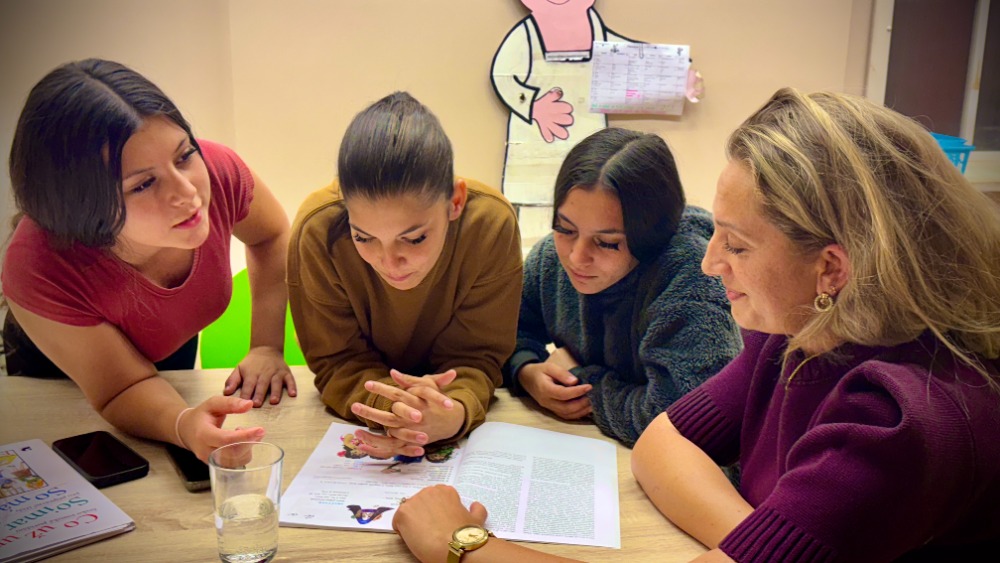
Even though they grow up without a family, they have dreams. Slovo 21 helps Romani children from children's homes
They don't grow up in "typical" families. But that doesn't mean they lack ambition, talent, or the drive to work on themselves. Our Avela project supports Roma children in their education and development across the Czech Republic – and some of its activities are focused on those living in children's homes.
.jpg)
Project Praha společně 2025 (Prague Together 2025) is coming to an end. What did it bring to Prague residents and foreigners alike?
Prague has long ceased to be a city only for Czechs. Today, approximately a quarter of its residents are foreigners who often struggle with a language barrier. The Prague Together 2025 project was created specifically for them.
.jpg)
Podphandle mašľičkenca – Tied with Ribbons. Slovo 21 is publishing literary testimonies from Romani women regarding forced sterilizations.
Forced sterilizations, supported by the state for decades, have altered the lives of thousands of Romani women and their families. Yet, Czech literature has remained almost silent on this trauma until now. Slovo 21 and our Romani writers' club, Paramisara, have decided to at least partially fill this gap. We are therefore publishing a collection of short stories titled Podphandle mašľičkenca – Tied with Ribbons.